
Practical Guide to Gamma Greeks
Apr 22, 2026 - Tribhuven Bisen
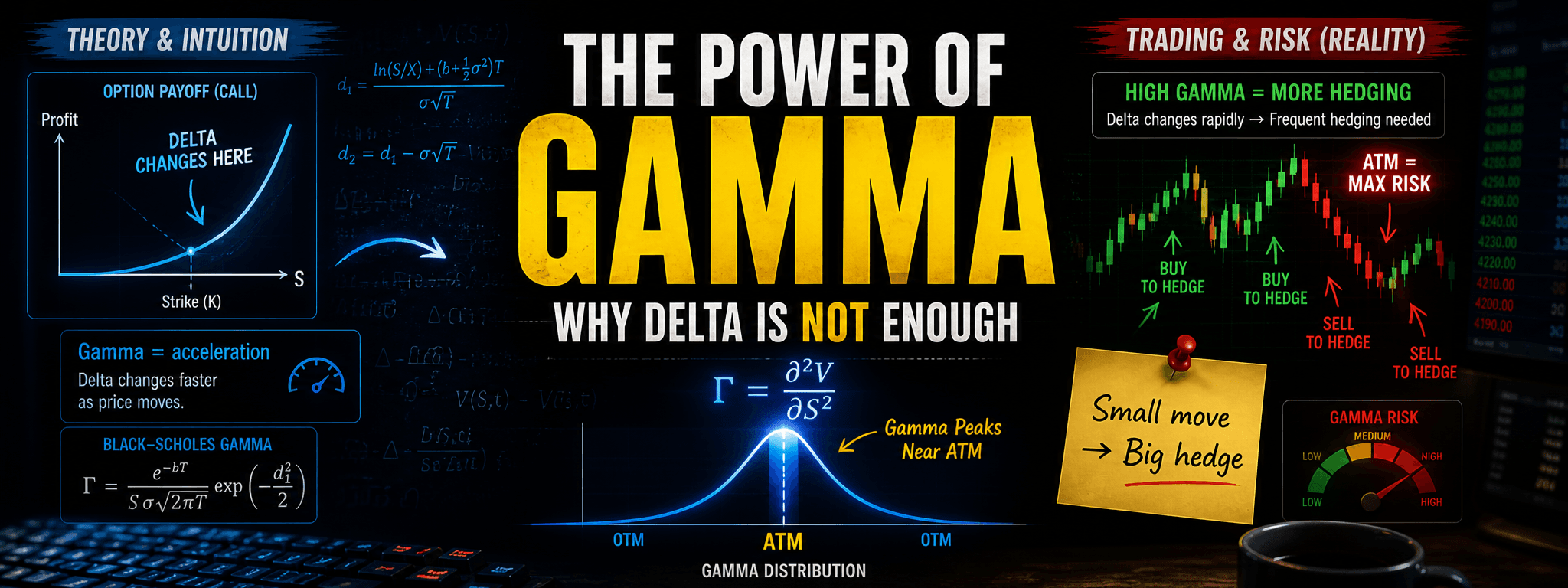
The blog explains how to compute and use Gamma and higher-order Greeks to manage hedging, volatility sensitivity, and risk dynamically in options trading.
Abstract
This article explains how to compute and use Gamma and related second- and third-order Greeks in real-world option trading and risk management. Included are:
- How to calculate standard Gamma () and interpret it in practice
- Approximations for fast evaluation (Saddle Gamma)
- Normalizing Gamma (GammaP) for position sizing
- Using Gamma symmetry for skew analysis
- Evaluating sensitivity of Gamma to volatility (VommaGamma)
- Using Speed () for dynamic hedging
- Using Color () to understand time decay of risk
Throughout, we show numerical examples and discuss how traders and risk managers incorporate these metrics into daily workflows.
1 Introduction
Gamma is a critical measure for understanding how an option’s Delta changes with small moves in the underlying. In practice, high Gamma positions require frequent rebalancing to remain hedged. This guide provides step-by-step formulas, numerical examples, and notes on how to integrate Gamma-related Greeks into trading systems and risk reports.
2 Standard Gamma: Calculation and Example
2.1 Formula
Under Black-Scholes, the Gamma for a European call or put is:
where
and
- S: current spot price of the underlying
- X: option strike
- T: time to maturity (in years)
- b: cost-of-carry (for stocks, typically r − q, where q is dividend yield)
- σ: implied volatility (annualized)
2.2 Numerical Example
Suppose:
- Underlying S = 100
- Strike X = 100
- Time to maturity T = 30/365 ≈ 0.0822 years (30-day option)
- Risk-free rate r = 5% annual; no dividends, so b = r = 0.05
- Implied volatility σ = 25%
First compute:
Then:
Numerically:
So
Gamma is 0.0310 per $1 move in S. A $1 move in the underlying causes Delta to shift by about 0.031.
2.3 Practical Notes
-
Hedging Frequency: With Gamma = 0.031, a $1 move in the stock changes Delta by 3.1%. For a $1 million notional position, daily price swings of $1 require adjusting Delta by $31,000 of the underlying to stay hedged.
-
Monitoring: Traders track Gamma not just at spot but across a grid of strikes and maturities (a “Gamma surface”) to see where risk is concentrated.
-
Real-Time Alerts: Set thresholds for Gamma changes; alerts notify traders when Gamma exceeds risk limits.
3 Saddle Gamma: Fast Approximation
3.1 Motivation
For portfolios with thousands of option positions, computing Black-Scholes Gamma for each can be time-consuming. Saddlepoint approximations offer a faster way to estimate Gamma when extreme moves or non-lognormal features matter.
3.2 Saddle Gamma Formula (Lognormal Case)
In Black-Scholes, the cumulant-generating function is
The saddlepoint solves:
so
Substitute into:
Pre-built libraries (in Python or C++) handle these calculations once parameters are specified.
3.3 When to Use
- Short-Dated Options: As T → 0, Gamma spikes; saddlepoint avoids numerical instabilities.
- Heavy-Tailed Models: For fat-tail returns (e.g., jump-diffusion), saddlepoint captures tail behavior more accurately.
- Speed: Reduces CPU time in risk systems recalculating Greeks for large portfolios.
4 Percentage Gamma (GammaP) for Position Sizing
4.1 Definition and Interpretation
measured as basis points of Delta per 1% move in the underlying. Traders use GammaP to compare risk across options on different underlyings.
4.2 Example and Use
Continuing the previous example with S = 100, Gamma = 0.0310
per 1% move.
If a portfolio has $200,000 in option Delta notional at that strike, a 1% move changes Delta by 0.031% of $200,000 = $62. This helps budget hedging costs.
4.3 Risk Limits
Institutions set limits on aggregated GammaP across all options to cap the total Delta shift for a given market move.
5 Gamma Symmetry: Skew Analysis
5.1 Put-Call Symmetry
Gamma symmetry indicates call Gamma at one strike equals put Gamma at a mirrored strike:
where
Traders use this to spot skew: if put Gammas at low strikes exceed call Gammas at mirrored strikes, the market is skewed.
5.2 Application
- Vol Surface Construction: Enforce Gamma symmetry when interpolating to ensure no-arbitrage.
- Skew Monitoring: Compare implied volatilities at K and F²/K; deviations signal directional bias or demand imbalances.
6 VommaGamma: Sensitivity of Gamma to Volatility
6.1 Formula and Calculation
VommaGamma measures how Gamma changes as implied volatility shifts:
6.2 Numerical Example
Using d1 ≈ 0.092, d2 = 0.0203, = 0.0310:
A 1% absolute increase in volatility reduces Gamma by about 0.00124.
6.3 Practical Notes
- Vol-of-Vol Risk: Positions with large VommaGamma are sensitive to volatility shifts. Hedge by trading Vega options.
- Risk Reports: Include VommaGamma exposure to assess how volatility surface moves affect hedging.
7 Speed: How Gamma Changes with Spot
7.1 Formula and Interpretation
Speed is the third derivative :
A negative Speed means Gamma decreases as spot moves away from at-the-money.
7.2 Numerical Example
Using , , , , :
A $0.10 move in spot changes Gamma by approximately −0.0000626.
7.3 Practical Implications
- Dynamic Hedging: Use Speed to estimate additional shares or futures to trade when spot moves a fraction, without recomputing full Gamma.
- Cost Estimates: Estimate transaction costs for small hedge adjustments.
8 Color: Gamma’s Time Decay
8.1 Formula
Color describes
Negative Color indicates Gamma decays as time passes.
8.2 Numerical Example
With , , , , :
For a 1-day (0.00274 years) decay, Gamma decreases by 0.1873 × 0.00274 ≈ 0.00051.
8.3 Use Cases
- Hedging Horizon: When Color is large, Gamma erosion is rapid; hedge more often near expiry.
- Margin Forecasting: Gamma affects margin; use Color to project margin requirements.
9 Implementing in a Risk System
9.1 Workflow
- Market data feed: Ingest live S, implied vols, rates, dividends.
- Batch Greek computation: Compute Γ, GammaP, VommaGamma, Speed, Color daily or on demand.
- Risk dashboard: Show aggregated exposures: total GammaP by underlying, VommaGamma by volatility bucket, largest Speed values.
- Alerts: Notify when Gamma or VommaGamma exceed thresholds or when Color signals rapid Gamma decay.
- Hedge execution: Use Speed and Color to guide size and timing of Delta hedges.
9.2 Sample Python Pseudocode
# Given S, K, T, r, q, sigma
import math
def compute_greeks(S, K, T, r, q, sigma):
    b = r - q
    d1 = (math.log(S/K) + (b + 0.5*sigma**2)*T) / (sigma*math.sqrt(T))
    d2 = d1 - sigma*math.sqrt(T)
    gamma = math.exp(-b*T)/(S*sigma*math.sqrt(2*math.pi*T)) * math.exp(-0.5*d1**2)
    vomma_gamma = gamma * (d1*d2 - 1)/sigma
    speed = -math.exp(-b*T)/(S*S*sigma*math.sqrt(2*math.pi*T)) * math.exp(-0.5*d1**2) * (2 + d1/(sigma*math.sqrt(T)) - d1**2)
    color = gamma*(b - (1 + d1*d2)/(2*T))
    gamma_p = 100 * gamma/S
    return {"Gamma": gamma, "GammaP": gamma_p,
            "VommaGamma": vomma_gamma, "Speed": speed, "Color": color}
10 Summary and Best Practices
-
Compute and monitor Gamma and GammaP daily for all liquid strikes; aggregate by maturity buckets.
-
Use VommaGamma to understand how Gamma profiles shift with volatility moves; hedge Vega accordingly.
-
Use Speed and Color to forecast hedging needs when spot moves or time passes.
-
Incorporate saddlepoint approximations in large-portfolio contexts to save CPU time.
-
Validate Greeks by backtesting small price moves to ensure model accuracy in production.